


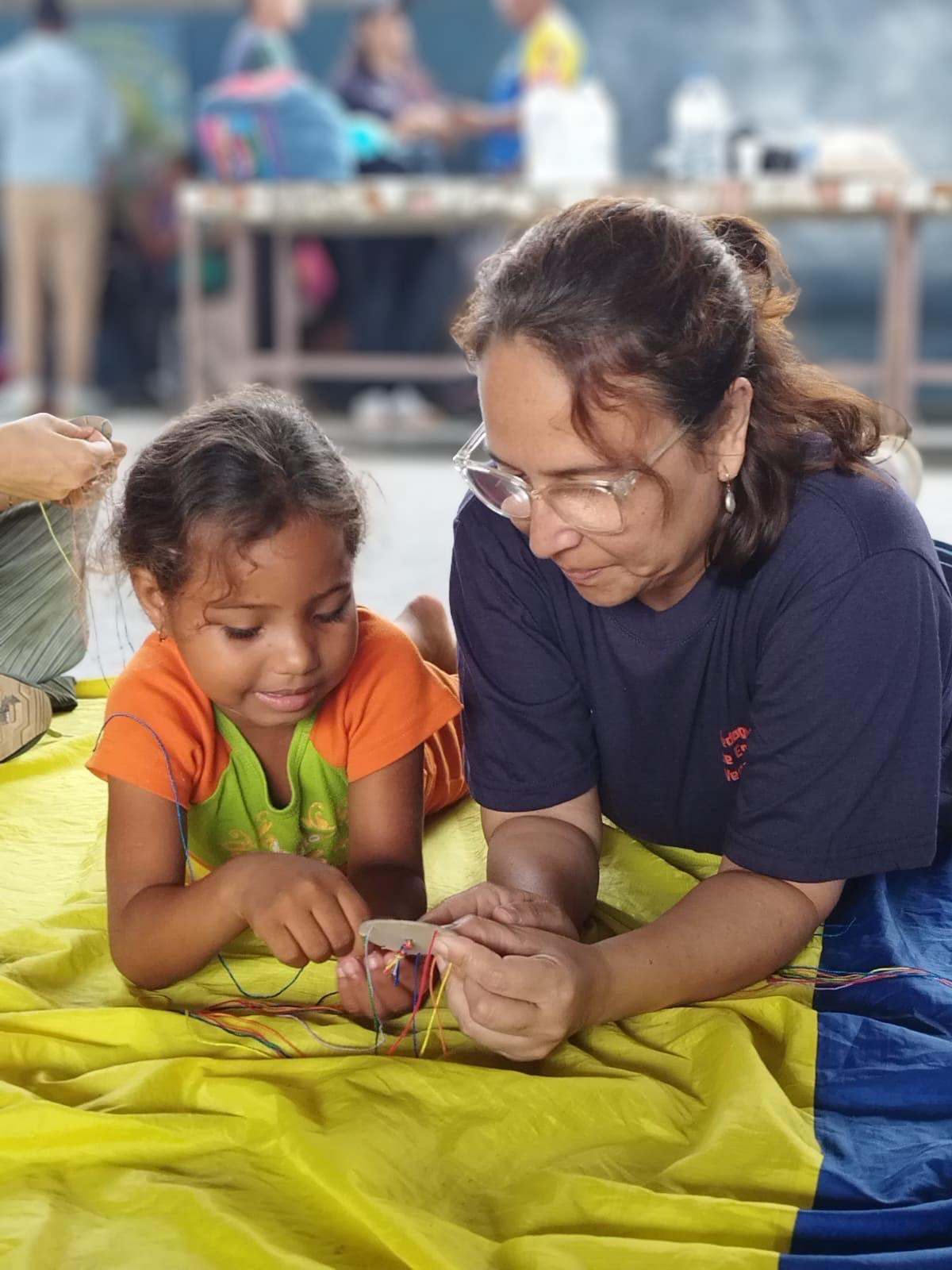
“During this week, I was able to rediscover something within myself that I had not felt for a very long time,” says Julia, the mother of Miguel, a boy with autism, reflecting on her experience following our emergency intervention in Venezuela. The many changes brought about by the earthquakes can be particularly challenging for children with autism. As a result, mothers often faced an increased burden in supporting their children. Part of the Emergency Pedagogy intervention therefore took place at a cultural center where the children already receive regular support.
Following a devastating event such as an earthquake, rescue and recovery operations may be completed within a few weeks. The full extent of the psychological impact, however, often only becomes apparent weeks or even months later.
Building knowledge and strengthening local networks
Led by Fiona Bay, the intervention began with a professional training course. Over three days, 85 people from a range of professional backgrounds—including psychiatrists, doctors, nurses, educators, psychosocial therapists, community workers, and humanitarian clowns—came together for an introduction to Emergency Pedagogy. Alongside providing participants with knowledge about psychotraumatology and Emergency Pedagogy, the training also supported professionals in dealing with their own psychological stress and emotional strain. Leticia Rea, one of the participants, described the training as “very enriching and deeply healing, helping us to calm our feelings of fear and distress.”
The introductory training was followed by six days of practical work with more than 1,100 children, adolescents, and adults affected by the earthquakes. During this practical phase, eleven aspiring Emergency Pedagogy practitioners from Venezuela joined the international team, gaining hands-on experience through on-the-job learning. Additional mental health professionals who had taken part in the introductory training also joined the team, giving them an opportunity to experience Emergency Pedagogy in practice.
The intervention took place in several settings: a cultural center supporting autistic children and their families; emergency shelters for internally displaced people from the Morón region; and within the family environment of a community near Valencia affected by both poverty and the earthquake.
Finding calm and security through creative activities
At the cultural center, mothers were surprised by the changes they observed in their children. They reported that their children with autism were noticeably calmer and more balanced, slept better, and came to the sessions with joy and openness. The relatives themselves also experienced greater calm, balance, and well-being. The intervention gave them some much-needed space and time for themselves, while their children were engaged in supportive activities.
Renata, an art therapist and Emergency Pedagogy practitioner from Argentina, worked with mothers and children using a variety of materials, including beeswax: “As one mother kneaded the wax, its smell brought back a memory of her grandmother. She remembered that her grandmother had used this wax to coat the threads she used when sewing shoes. This forgotten memory became a biographical resource for her.”
For one boy with autism, too, the beeswax seemed to open doors that had long been closed. Through stimulating the sense of touch and the warmth generated while kneading the wax, feelings of safety and trust began to return. The children also started shaping marbles and playing together.
Creating a safe space wherever it is needed
A student from the Waldorf teacher training seminar in Venezuela described her work in one of the emergency shelters:
“I volunteered with the group accompanying children between the ages of 0 and 7. In order to carry out our activities there, it was essential to create an atmosphere in which the children felt welcome and where we could spend time together in an environment of well-being and trust. There was only one tree providing shade, so we cleaned the area beneath it. Every day, one of my first tasks was to lay several meters of tarpaulin on the ground and cover it with a large pink cloth and a light blue one. This became a place where we could sit with the children and draw, weave, sing, or tell stories together. Preparing this protected and welcoming space for the children in just five minutes each day felt like receiving the gift of a moment of magic in their often difficult everyday lives. It was as though we could paint a world full of color and joy onto their surroundings, their faces, and their hearts.”
Strengthening local capacity for the future
Despite the challenging conditions and the need to approach potential trauma with great sensitivity, the people on the ground demonstrated remarkable strength and a willingness to seek support and build connections. Bringing together professionals from different disciplines through the multiplier training also created opportunities for collaboration that will extend beyond the intervention itself. By sharing knowledge and developing a common understanding of trauma-sensitive approaches, local professionals can continue to support affected communities after the international team has left.
A further intervention is planned for the autumn. Its aim will be to continue accompanying the local teams, deepen the work already begun, and further strengthen sustainable local structures for trauma-sensitive support. The work in Venezuela shows that Emergency Pedagogy is not only about responding to immediate crises. It is also about rebuilding trust, strengthening local resources, and creating spaces in which people can reconnect with themselves and with others, even in the aftermath of profound loss.
This project is made possible thanks to financial support from Aktion Deutschland Hilft. If you like what we do at the Department of Emergency Pedagogy and would like to support our work, please click here: