


In Gaza, uncertainty has become part of everyday life. For example, I do not know where I will be living in a few days. At the moment, I live in a rented room in the village of Al-Zawaida, about three kilometres from Deir al-Balah. As Israeli evacuation orders continue to expand, the family renting me the room may soon need it for displaced relatives. If that happens, I will have to leave and look for somewhere else to stay, just like thousands of other people. This is what life in Gaza looks like today. Even the slightest sense of stability can disappear overnight.
But at least I know where every morning begins: at the “NAWA Centre”, where the children wait for the doors to open. Doors to a place that gives them a sense of safety for a few precious hours. The children’s fears are no longer about school exams or homework. They are afraid of drones in the sky, evacuation orders and losing their loved ones. Many schools have become emergency shelters for displaced families, while others lie in ruins. For many children, there are no spaces left in which to learn and play.
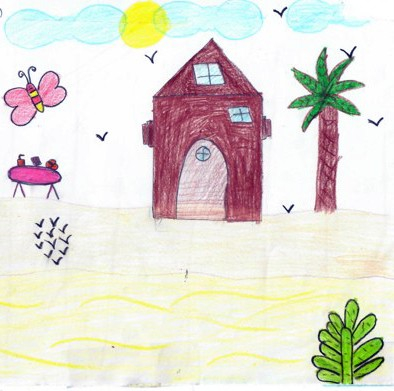
The children arrive full of fear, uncertainty and difficult questions. Later, they leave with a new story, a drawing or a smile they had almost forgotten. We read, draw, play and learn together, but above all, we listen. Because that is what many children need: someone who will listen to them. At the end of each day, it is not the number of activities that we remember most. It is the words the children leave us with. Qais, for example, told us about his dream while showing us one of his drawings: “I like drawing bulldozers. One day I want to have one, clear away the rubble and build a road.” Qais’ family home was destroyed during the war. Yet his drawings, like those of many other children, are filled with houses, trees, spring flowers and the sea. They tell the story of the life these children still dream of, despite everything they have lost.
We know that our work cannot stop the destruction. It cannot rebuild collapsed houses or make the children’s fears disappear overnight. But it can give them something equally important: a place where they can learn, play, express themselves and remember that their childhood is still worth protecting.
Perhaps tomorrow I will have to look for a new place to live, perhaps I will not. But one thing is certain: when my colleagues and I open the doors of the “NAWA Centre”, the children will come. One child will arrive with a new story. Another will draw the path they want to take one day. A mother will be able to breathe a sigh of relief, knowing that her child is spending a few precious hours in a safe place where they are cared for and encouraged to believe in their future.
We may not be able to change what happens beyond our walls. But every morning, we can open a door. And behind that door, a child can learn, laugh and dream again. Perhaps hope in Gaza today begins with something as simple as this: a door that opens every morning.
Amal Al-Shurafa