


When the severe earthquake struck eleven towns in southern and south-eastern Turkey in February 2023, I knew immediately that I wanted, above all, to help the young children in this situation. Together with an emergency pedagogical team from the Friends of Waldorf Education, I travelled to the area just one month after the disaster. We wanted to reach the children as quickly as possible. Once there, it became clear just how difficult the situation was, especially for the young children. We immediately observed all the behaviours described in the specialist literature as examples of how children react under stress: anger, lashing out, or crying, as well as difficulties in socialising, listening, concentrating and following instructions. All of this was clearly visible. And then there was the ‘silence’ that is not described in the textbooks, namely, a deep, unsettling silence that was still present even three months after the earthquake. It means that children cannot express their thoughts and feelings and that they are ‘stuck’. We wanted to overcome this silence, and it was clear to us that to do so, the children needed reliable opportunities to play, move about and socialise. For this reason, we set up two Child Friendly Spaces for young children in Hatay.
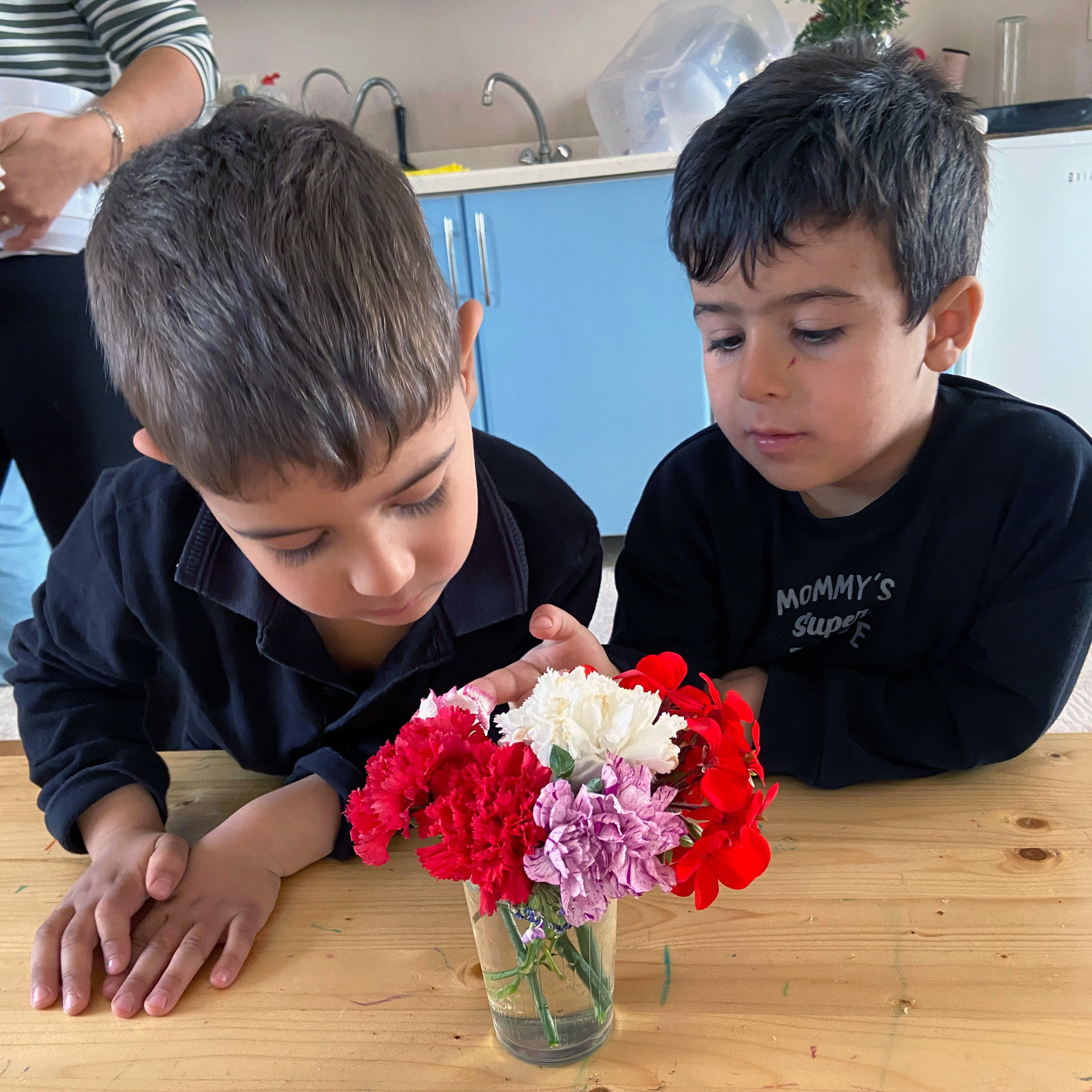
In these spaces, the children find warmth: in the way the teachers treat them, in the herbal teas, and in the freshly baked bread. Warmth is the first step towards overcoming stress and building trust. After that, rhythm, play and art take centre stage. To enable children to express and thus process their feelings, they need constant opportunities to sing, paint, run, play and laugh. Listening to stories being read aloud is also very important – as is the chance to create their own stories.
At the beginning, the traumatic effects of the earthquake were clearly visible in the children. I saw children running non-stop, as if they hadn’t managed to escape the earthquake in time. Then there were children playing in the smallest of spaces, even though they had an area of 50 square metres at their disposal – a clear sign that they had no inner space in which to spread out freely. Some played alone, even though there were 20 children in the same room. I listened to their conversations and stories about the earthquake and watched games in which injured people were taken to hospital by ambulance. Many children showed fear at every loud noise. A child with short hair crouched in the corner and pulled out her hair. Above all, however, it was difficult to detect a sparkle in the children’s eyes.
At the end of each intervention module, which lasted around four months, it was time to say goodbye to the children. We saw children who were completely different from those at the start. They talked, played, created things and – most importantly – told jokes.
I saw the girl who had stopped pulling out her hair – now with long hair. At the same time, I also saw relieved mothers who had been given the chance to have time for themselves again, to make friends, to talk about their worries, and to receive support for their children’s development.
More than 100 children have now played in our Child Friendly Space. Over a period of four months at a time, for three hours a day, we supported them in building their own future. All this work has clearly shown us that, through warmth, rhythm, art, play and stories, we can help children adapt to life at an early stage. It has also highlighted to us the importance of time and support for mothers in order to continue the healing process.
Even three years after the earthquake, many people are still living in tents and shipping containers. Children continue to see destruction. They continue to hear their families’ traumatic accounts of the earthquake – even if they themselves were not yet born at the time. This means there is still a great need for spaces where young children can play. And there remains a need to consider how best to support children born into disaster-stricken environments.
Cansu Kaygısız Vardar,
Project Manager, Emergency Pedagogy, Turkey