


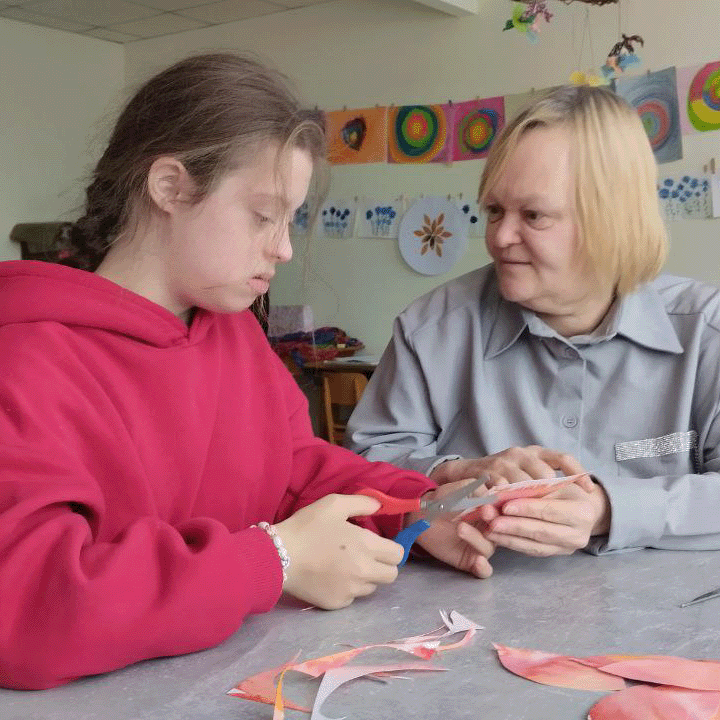
In Ukraine, the topic of “inclusion” was not widespread even before the full-scale invasion. Children with disabilities were generally isolated. Many did not attend school but were taught at home. They also had very limited access to recreational activities. The ongoing war has further worsened their situation: many had to leave their homes and thus lost their safe space and familiar daily routines. In addition, frequent air-raid alarms, explosions, and stays in shelters place a particularly heavy burden on these children.
For children with disabilities, resilience may be less pronounced, meaning that their coping strategies can reach their limits more quickly in difficult situations and trauma can develop. They therefore belong to a group that very often experiences traumatic events, yet these traumatic experiences and their possible consequences are most frequently overlooked. Many symptoms of post-traumatic stress disorder resemble the symptoms of disabilities, making the identification of trauma more difficult. Additionally, the children often struggle to reflect on themselves and explain their experiences. We often look for an objectively threatening event, while people with disabilities may perceive many situations as existentially threatening long before they are recognized as such. Therefore, we often do not know whether and how many traumatic experiences these children have endured. Emergency pedagogy helps them activate their inner healing forces.
The trauma pedagogy center “Harmony” in Odesa has developed a concept to promote an inclusive society in which children with and without disabilities and their parents perform concerts together. These spaces help to foster understanding and acceptance and to reduce prejudice: what you can do is enough, and how wonderful that you are here! Our colleagues from Odesa report that the project also gives parents a new perspective on their children, enabling them to recognize their extraordinary abilities and potentials.
This year, the non-governmental organization (NGO) Megasvit in Vinnytsia is also gaining its first experience working with children with disabilities in cooperation with the Emergency Pedagogy department of Friends of Waldorf Education. Through her work, Nataliia Povolotska from the NGO discovered how important the principles of emergency pedagogy are especially for these children; principles such as a safe space, relationships, appreciation, and self-determination. When these principles are considered, the children participate in activities in a completely different way, laugh a lot, and show developmental progress, Nataliia tells us.
In many other places, knowledge and experience in working with children with disabilities are still lacking. That is why we regularly conduct trainings or seminars worldwide with a focus on “Trauma and Disability,” in order to foster awareness and competence. This was also the case in the Waldorf Kakuma Project in northern Kenya, where 14 teachers are active in three different child protection centers. The topic sparked great interest, and a colleague on-site shared how the training changed his perspective and his work: “We are creating a space where children with and without disabilities can learn, play, and grow together. I witnessed how a child who was initially shy gradually gained confidence through art and play and participated joyfully in the activities. These moments show how inclusion, creativity, and community strengthen children’s self-confidence and future opportunities.”
As Friends of Waldorf Education, we are committed to ensuring that children with disabilities receive the same acceptance, appreciation, and opportunities for their development and for a good life.
Kseniya Karman Samet and Fabian Krämer