


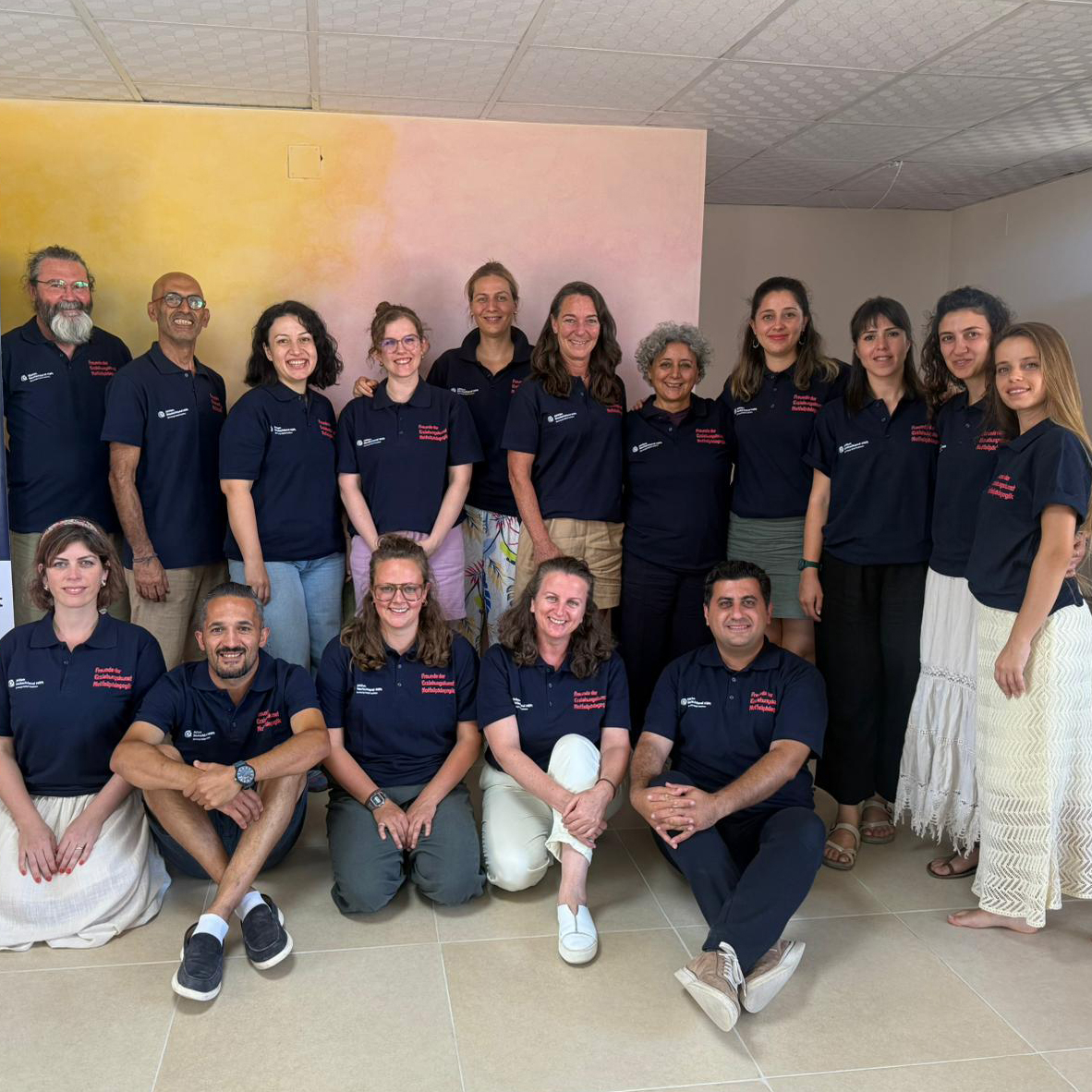
After the introduction to emergency pedagogy and psychotraumatology in October 2024, the second module in January focused on the topics of “Stress” and “Rhythm,” explored both theoretically and practically, including eurythmy exercises. The third module, at the end of March and beginning of April, concentrated on “Attachment Theory” and “Salutogenesis,” enriched by practical artistic work. In July, two modules took place: “Mental Hygiene and Psychoeducation,” as well as “Emergency Pedagogical Interventions and Working with Large Groups.” Already during the third module, participants were divided into small teams tasked with preparing a final presentation on one of the topics. Thus, the final session in Hatay not only revisited and consolidated the themes covered, but also offered space for deepening and strengthening what had been learned.
Following the successful completion of the training, the newly formed teams will now carry out introductory workshops on “Emergency and Trauma Pedagogy” in various regions of Turkey. These regions were selected either because they were affected by the earthquake or because they are seismically active zones that may be impacted by future earthquakes. The aim of these workshops is to raise awareness among local pedagogues of the importance of emergency pedagogy for children and young people, while at the same time offering them concrete tools for their work. Moreover, these workshops provide an opportunity to build a network in Turkey that can continue the work independently.
The entire project, and in particular the completed training, also had a profoundly empowering effect on the Turkish team. As local project manager Cansu Kaygisiz-Vardar shared: “After the earthquake, we felt helpless and asked ourselves: what can we do? The project and the training have strengthened our ability to act, brought us closer together as a team, and shown us what we are capable of achieving.”
Our earthquake relief project, financed through Aktion Deutschland Hilft, will come to an end in December 2025. We look back on two intensive and eventful project years: almost 1,000 children participated in emergency pedagogical activities during three international interventions, 400 people attended introductory trainings, 100 children regularly visited two Child Friendly Spaces in Hatay, and 30 Syrian teachers took part in hybrid trainings.
Lina Bäuerle