


During my stay, I accompanied the seven classes, whose classrooms have aged significantly. Even though the plaster is crumbling, singing, painting, and learning continue. In front of the small buildings stands the (hopefully full) water tank for drinking water. Water supply is interrupted almost as frequently as the electricity. This affects the recently donated fans in the classrooms, where up to 40 children sit close together at their desks in subtropical 38°C heat, learning with doors and windows open. In the morning, songs in Swahili and English are sung, and the rhythmic part of the lesson takes place either in the pavilion or under shady trees for the lower grades. Parents value the Waldorf pedagogy because their children learn with joy — something hard to imagine in state schools where classes often exceed 100 students.
There are two shared meals for all pupils; ugali, rice, and beans are the staple dishes. In a tiny kitchen with two gas burners, an always cheerful cook prepares daily meals for nearly 300 students and teachers.
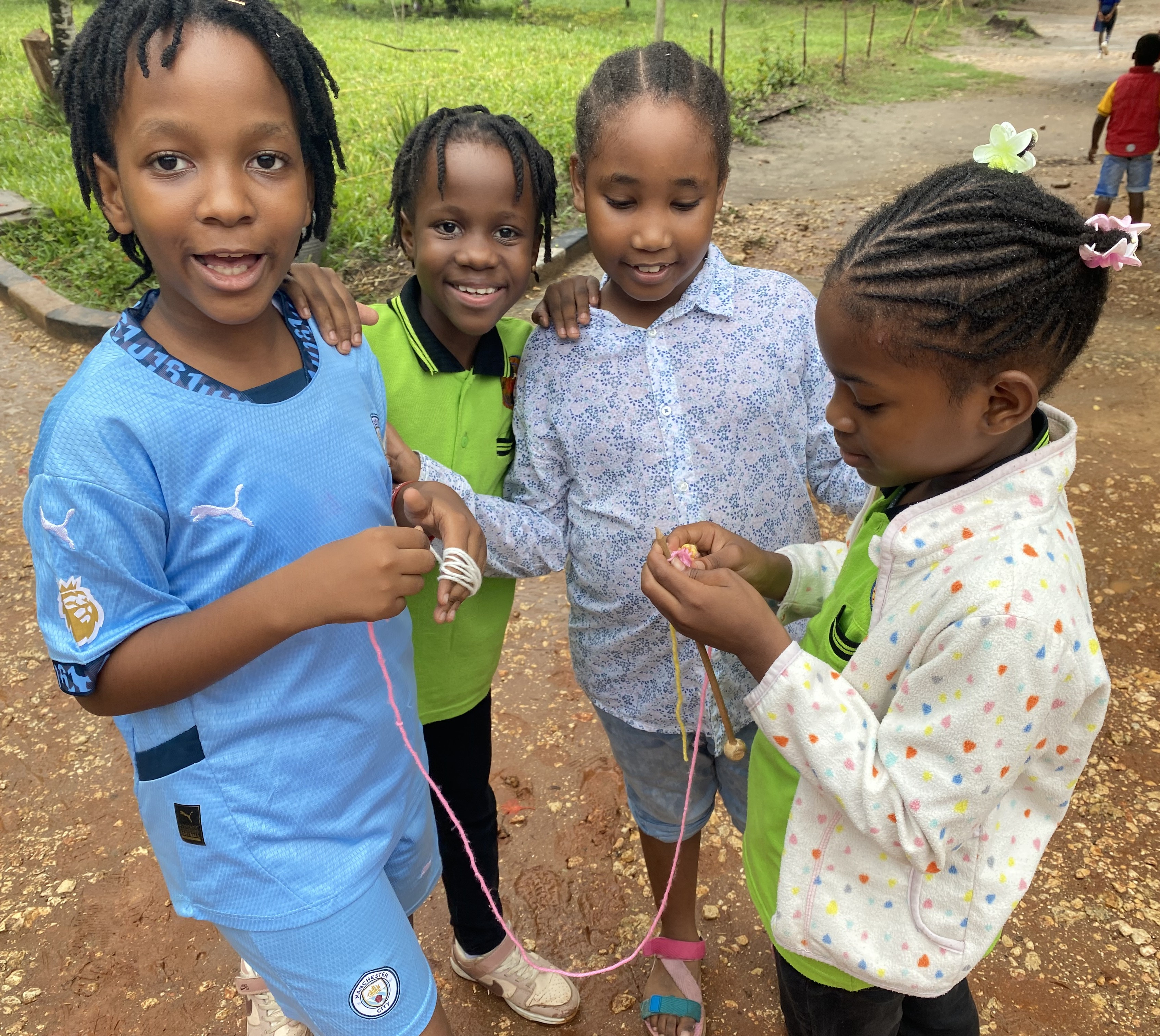
The school grounds offer enough space to play, climb, and, depending on age, even knit after lunch. After the afternoon lessons, the school buses are already waiting to take the children home. There’s no room left on the buses — demand for a good school is high.
From the nearly completed pavilion, used for gatherings, eurythmy, and choir, the view extends beyond the adjacent workshop hut over the sand court to the kindergarten, located in a hollow, where 70 children are grouped by age. What a joy and a flurry of activity when all the children sing, play, and work in the open spaces before playing outside. After lunch, there’s nap time on mattresses before the children go home.
Some parents struggle to pay tuition on time. To allow some children to continue attending with financial support, generous parents and sponsorship donors from the Friends of Waldorf Education additionally support the school. However, it remains uncertain each month whether income will cover expenses and salaries.
Meetings are held in the small library, while teacher conferences take place under the awning. Seventeen teachers are responsible for running the school — including administration — on top of their diverse pedagogical duties.
There has long been both a desire and a need for a quiet room for conversations or preparations, and for larger classrooms that can accommodate shelves for books, notebooks, and learning materials. To realize this project, it takes a conscious and united teaching staff working together to shape the school internally and externally for the future. Sometimes, however, this will to shape things falters and the essential is forgotten. In such crises, an external mentor's perspective can be helpful. After all, crises always present opportunities to bring movement into everyday school life through newly gained insights and approaches.
For many years, I have supported Waldorf schools in various countries and cultures, adapting to each one’s individual circumstances and needs. As a former class teacher and mentor, I know I must constantly embrace unfamiliar situations. My work requires both stability and flexibility, along with fundamental pedagogical experience. It's also important to listen and not always jump in with a ready-made solution. In conversation, the teacher often arrives at the solution on their own. Still, there are situations in which decisions must be made for the benefit of the child, the school, or the teacher — decisions that are not always easy.
During my three-month mentorship at Hekima, I conducted classroom observations to improve teaching quality across all classes and with nearly every teacher. It's often more helpful than expected to offer an external perspective on lessons, provide input, and offer encouragement. Discussions about individual students and the Waldorf pedagogy benefit every teacher. A healthy school system grows on a solid foundation, one where the children of the future can learn happily and become free-thinking individuals!
My work as a mentor challenges and enriches me daily through its variety and through interactions with people with whom I share experience and knowledge — and for whom the child is always the focus.
Ortrud Schmidt
The Friends of Waldorf Education have supported the Hekima School since its founding, funding both the land and the existing school building. They are currently in discussion with the school association’s board about new classrooms that are due to be built soon. The building that becomes available as a result will, as originally planned, house the kindergarten. We would most gratefully accept donations for the construction of the new classrooms.
The Friends of Waldorf Education are regularly asked to arrange mentors who can help teachers around the world improve the quality of their teaching. With experienced teachers interested in such a role, we conduct preparatory conversations, and when offer and demand align, we arrange for these volunteer mentors. Because this mentoring work can only be done on a voluntary basis, it is especially suitable for recently retired class teachers. Anyone interested in a role like this is welcome to contact Nana Goebel.