


In a conversation with Deputy Minister Araksiya Svadzhyan, the idea for a ‘Pedagogical Club’ was born. We discussed how the state education system could be improved. My advice was: invite a few people you respect and trust and start meeting with them regularly in an informal atmosphere. The response came very quickly: a group was formed on the initiative of Minister Zhanna Andreasyan. The members of the club are the minister herself, the deputy minister, the head of the Parliamentary Education Commission, the head of the Department of School Education, the head of the State Education Inspectorate, the director of the Institute for Pedagogical Innovations, and several well-known teachers in the country, heads of independent schools and representatives of public organisations. There are around 15 of us in total. We meet informally every three to four weeks on Friday evenings at one of the institutions hosted by one of the club members. First, the hosts present their activities for about an hour, then the conversation continues over tea and coffee for two hours, sometimes longer, on a previously selected topic. Either the minister, the deputy or both are present at each meeting. The discussions are open, sometimes very heated, but always friendly.
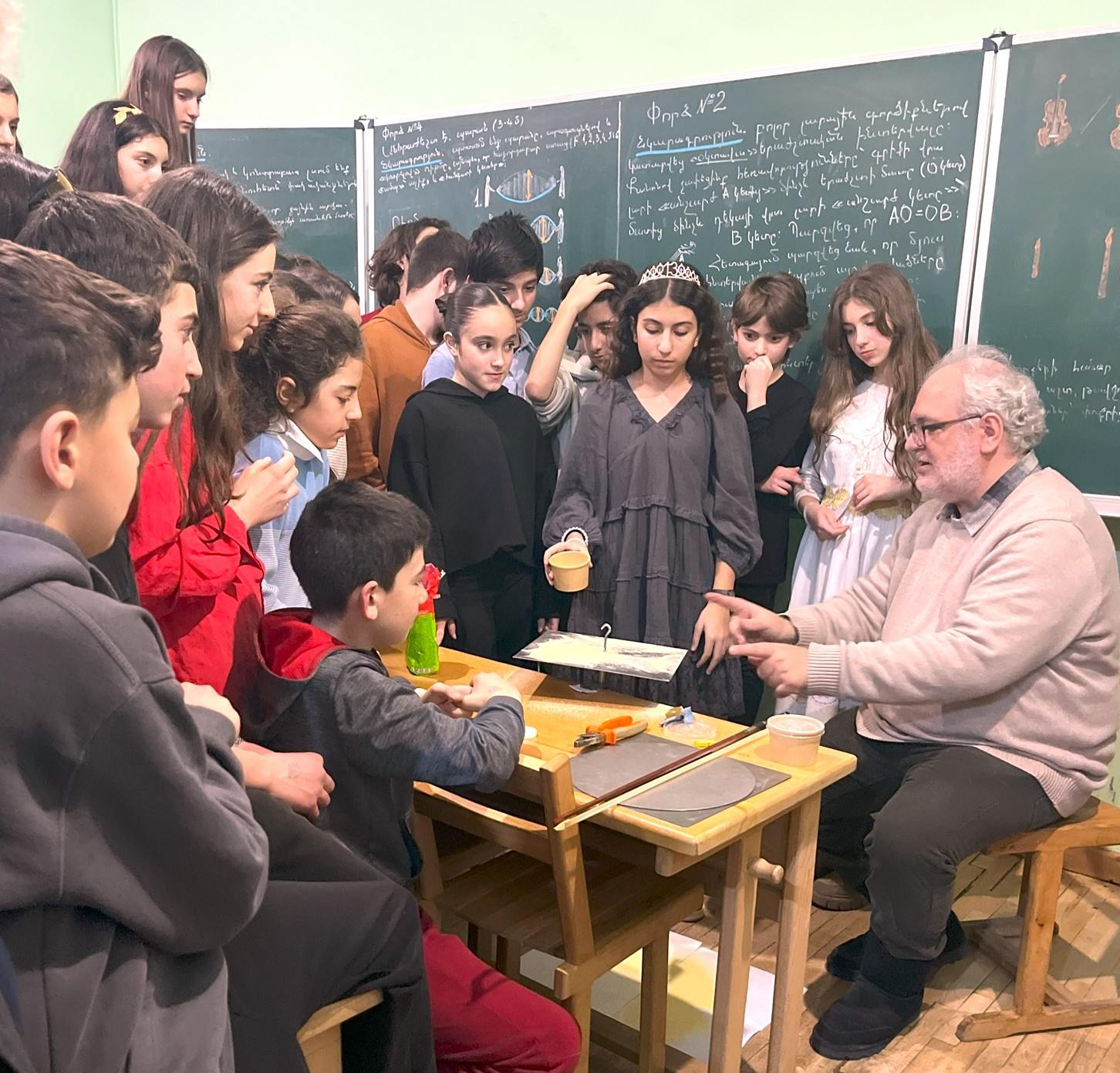
On 7th February 2025, the Pedagogical Club was a guest at the Aregnazan Waldorf School. The guests toured the school's classrooms and corridors for an hour. Despite the fact that it was evening, we created the atmosphere of a school day for them. The seventh-grade students performed eurythmy, a rondo by Mozart and a poem by Sappho. Then the guests watched an excerpt from a physics lesson - the Chladni plate sound experiments. The eighth grade dealt with geometry and astronomy - they created the five Platonic solids in connection with Johannes Kepler's astronomical model. In music lessons, the ninth class showed how Armenian folk songs are arranged with flutes, recorders, violins, guitars, cellos and percussion instruments. In the tenth grade, the guests saw a circus performance, while in the eleventh grade they listened to traditional and modern music in lively, original arrangements. The club members also looked at the students’ lesson books covering history, biology, astronomy, physics and geometry, viewed an exhibition of handicrafts on the subject of work from first to twelfth grade, and looked at the teachers' beautiful blackboard pictures - none of this was specially prepared, it was simply part of our daily work. At the end, the visitors received books published by the school with the support of the Friends of Waldorf Education. This was followed by a discussion round on the topic of ‘alternative schools’.
Our task was not only to show spectacular, bright fragments of the educational activities and the children's work in a Waldorf school, but above all to emphasise that it is possible to work in such a style that is radically different from all the usual approaches. We also emphasised that the highly skilled eurythmy, musical and circus acts are not the result of the work of special groups that include only highly motivated and talented children but are part of the working process in which everyone is involved. Physics, geometry and astronomy are also taught in such a way that they attract the attention of the whole class and not just a small group of gifted children.
During the discussion, it was stated several times that the guests were very impressed by what they saw and that they will think about using our experience in state schools. As the head of the Ministry's school education department Tamara Sargsyan said: ‘I see the most important thing - your children don't want to go home from school, and we need to think about how we can do that in state schools.’ At the same time, we managed to emphasise that it is not just about giving a good impression of Waldorf education and our school, but to show once again how important it is to have alternative approaches to education.
Some important changes have already been made to the state curriculum, which were only possible thanks to the active participation of Waldorf schools in the development of the new educational standards and the support of the Minister: the abolition of grades in state schools until the middle of the fifth grade, the increase in the scope of artistic subjects, the introduction of lessons up to the twelfth grade, and the introduction of alternative forms of knowledge assessment, especially individual and group projects. What is even more surprising is that two of my books, written in full accordance with the Waldorf programme, won a competition and became textbooks for public schools. However, these are not even schoolbooks in the true sense of the word, but two fictional stories containing educational material. Today, 40,000 Armenian children learn with these books in regular schools.
The club meetings continue, the next one will be dedicated to the problems of the ‘State Educational Standards’, and ideas for their improvement. It looks more and more like a team of people with very different ideas, but good will, and the same great ideal - to create a really free and good education and to have many different schools where children are happy.
Ara Atayan