


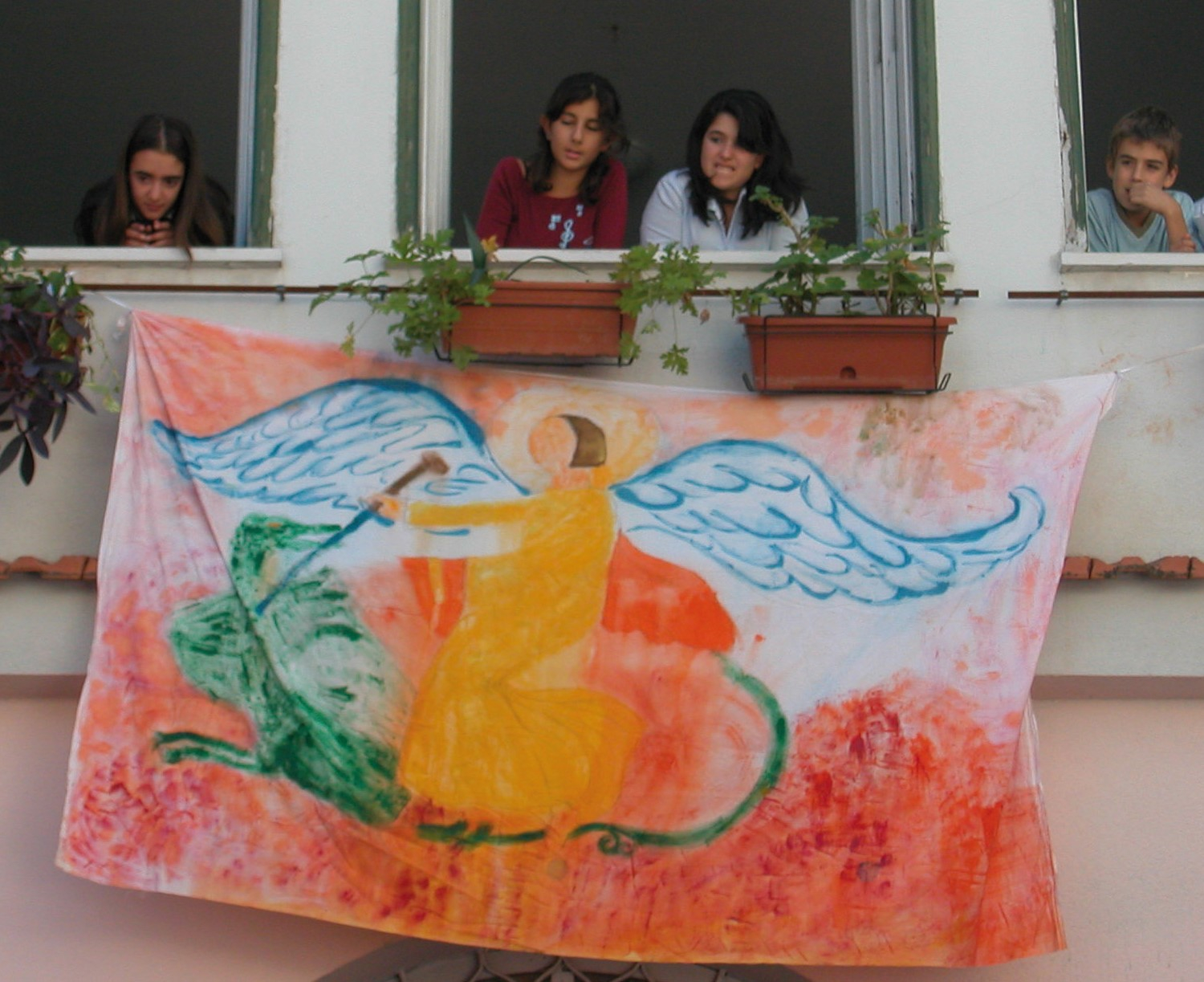
If you walk along the densely built-up Via Parlatore in Palermo, end up at a café and see familiar faces there, you have gone a little too far and overlooked the metal gate to the oldest Waldorf school in Sicily. Since 1992, one of the southernmost Waldorf schools in Europe has been located in Palermo, in the centre of the noisy city, which is characterised by major economic and social problems. Dr Stephan Heinzmann, one of the founders of the Waldorf School in Palermo, once wrote: ‘Palermo is a city of screaming contrasts, the likes of which are almost unheard of in Europe: a new airport, luxury goods, big cars, guarded villas and collapsing old buildings, entire streets without sewage treatment plants, and no money for school buildings – the state rents residential buildings for schools!’ The school struggled for many decades and had repeatedly to take out loans from theFriends of Waldorf Education in order to pay the teachers' salaries. And there were actually no prospects for growth in the labyrinthine school, whose rooms are housed in various buildings adjoining the rear courtyard. But how can you summon up the courage to change location if you have no money and are worried about running the school by self-administration?
We are repeatedly confronted with the question of why the Friends of Waldorf Education also support Waldorf schools in Europe, and why we support European Waldorf schools financially. We and our donors are committed to supporting Waldorf schools in places where they are not quite able to manage on their own. Some countries in southern Europe are not all that different from the situation in Latin America, for example, where the contrasts between rich and poor are also obvious, and independent schools can only exist thanks to the commitment of parents.
It was only after the end of the Franco regime in 1975 that there was any chance at all of founding Waldorf centres in Spain. Some of the pioneers of this time, such as Antonio Malagon in Madrid and Auria Gomez Galceran in Barcelona, are still actively shaping the Waldorf movement today. It was only after the turn of the millennium, and with many parents from different countries that further Waldorf schools were founded in Spain outside the urban centres of Madrid and Barcelona. Today, there are 18 Waldorf schools from Lugo in Galicia, via Vittoria Gasteiz in the Basque Country, Bellaterra in Catalonia, via Alicante on the Costa Blanca to Malaga in Andalusia.
In order to be recognised as a school in Spain, considerable structural requirements need to be met. Not all schools fulfil these requirements, which is why some schools operate as so-called international schools with US accreditation. A few years ago, those responsible at Escuela Waldorf Alicante decided to work as a state-recognised school in the future, similar to El Til-ler in Bellaterra or Escuela Waldorf Madrid. An alternative therefore had to be found for the very cosy tipi tents that had previously served as classrooms. The tipis were set up on a site next to the old villa, which still serves as a kindergarten building today, and is reminiscent of the elegance of the coastal town. Initially, a new building was designed to replace the tents, but this turned out to be completely unaffordable. Then a colleague discovered an abandoned building of a public school about 15 minutes away by car. Even if the aesthetics of this school building were not convincing, it still had great advantages: above all, a school licence. The building was rented and remodelled, which was only possible thanks to the great commitment of the parents and with the help of the Friends of Waldorf Education. However, the economic problems have not yet been overcome.
Much more commitment from the Friends of Waldorf Education was needed to help the Trianemi Waldorf School in Athens, the pioneering Waldorf School in Greece, founded in 2017, to have its own building. Greece's social and cultural climate, as well as its education legislation, did not allow the establishment of independent schools for a long time. Although there are public schools, they all have to teach the state curriculum, which is planned by the Ministry of Church Affairs. It therefore took great courage and skill to open the first Waldorf school in Greece. Very well prepared, Trianemi started in a former kindergarten building rented from a bank and soon became very popular. All classes are full, and the waiting lists are long. Trianemi managed to survive the pandemic and forge ideas for its own building during the Covid period, as the kindergarten building could only accommodate the primary school, which in Greece lasts six years. Growth was out of the question in this building. A plot of land was found and purchased in the same neighbourhood of Maroussi in the north of Athens. A separate building is now being constructed here, which will provide space for a two-form primary school and a single-form secondary school (grades 7 to 9 in Greece). As is common in many southern countries, parents only believe in a school when it is visible. So, there was no other option but to pre-finance the building with many loans, including large loans from the Friends of Waldorf Education, and then repay these through school fees. The school will move into its new building in September 2025.
As Waldorf schools are always the result of a combination of educational and social concerns, all Waldorf schools in southern Europe are fighting to enable children of parents who cannot afford a place at school to be able to attend. This is why the educational sponsorship programme of the Friends of Waldorf Education is so important, as it ensures the social integration inherent in Waldorf education.
In the meantime, the Palermo Waldorf School, again supported by the Friends of Waldorf Education, has acquired the Villa delle Rose, a 19th century monastery. It will take a few years for all the permits to be obtained in the south of Italy and for the renovations to take place, so that the teachers and school board members expect to be able to move into the building in 2027 and finally, finally, after 35 years, have enough space for the kindergarten and all classes.
Nana Göbel