


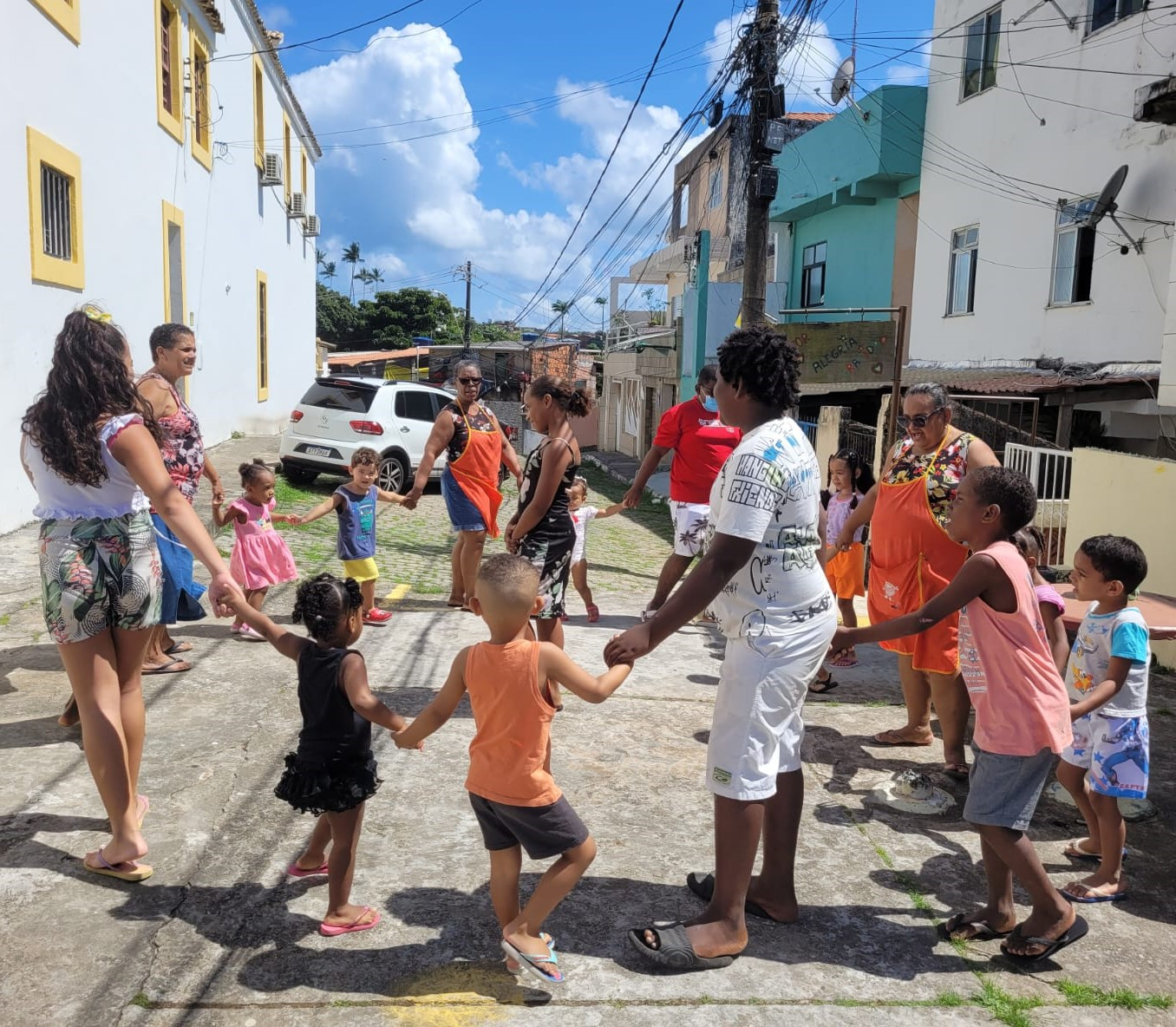
‘From the rather affluent neighbourhood of Ondina, you can reach the top of the São Lázaro hill, where the Projeto Salva Dor kindergarten is located, via various paths and alleyways. The sky is mostly blue, like the sea, which can be admired from the top with a sweeping view of the turquoise horizon. The path to Projeto Salva Dor reveals the daily struggle of the people for a dignified life. It becomes clear that the state hardly provides any infrastructure. It is thanks to individual people that the surrounding area is a decent place to live, thanks to self-organised rubbish dumps, improvised facades and roofs, as well as self-managed water and electricity supplies.
So, I set off early in the morning to visit the teachers and children of Projeto Salva Dor at the top of the hill. I met residents of the neighbourhood, for whom the working day had already begun with many tasks and challenges. There was also a woman sitting in the middle of the street who was already drunk so early in the day. For her, this day obviously offered no prospects, no task. At least none that she could manage that morning. Her five children, aged between two and twelve, were playing unsupervised, exposed to the adventures and risks of the streets of a socially disadvantaged and precarious neighbourhood.
When I arrived at Projeto Salva Dor, a completely different world opened up to me. A protected space of love, empathy and care. It was nap time. The children had already eaten and were resting in their group rooms under the supervision of their teacher Rosângela. In the kitchen, the cook Selma Ribeiro told me with great enthusiasm what was for lunch. She also handed me the recipe for a home remedy for coughs, which she was preparing with various herbs and roots from the region, and which worked very well. At that moment, the staff seemed like true angels to me. Especially because I knew that they had been working for free for several months and that some of the food they served there was brought from their own households.
Since the coronavirus pandemic, many circumstances have also made the work of the educators at Projeto Salva Dor more difficult. State and private partnerships and collaborations have collapsed since then. I wondered where the teachers found the love and strength to continue working here, and to be present for these children with such dedication. Perhaps they do it because they know exactly what their work means for the development of each individual child. As if they could judge exactly where the children would be and what they would be doing if Projeto Salva Dor didn't exist. And yes, they know exactly, because they all grew up there. Perhaps they too find a place of care and love in their educational work and in this community, which gives them support in their hard struggle for a decent life.
I left the centre with mixed feelings. Feelings of admiration and indignation; of hope and powerlessness.
Back in Berlin, I have no choice but to continue my commitment to this work, to this community and to the 40 children, and I ask you to do the same.
Projeto Salva Dor has been putting up resistance for 24 years. Resistance against a social structure that marginalises people. It is a fight for the rights of children. The right to healthy physical, mental and spiritual development. The right to an environment that is free from fear for their leisure activities, the right to a dignified life.
And for this, the project needs our support. For example, renovation of the building is long overdue! Any commitment is urgently needed and very welcome. Get involved on Wow Day, for example, or by taking on educational sponsorships and volunteer support, or by making a donation!’
Andrea Naka Marinkovic