Emergency and trauma pedagogy work after the 2023 earthquake
Third Emergency Pedagogical intervention
Even though the earthquake happened almost 10 months ago, thousands of people are still living in emergency shelters, many children are unable to attend school and the approaching winter is making life even more difficult. “The recurring aftershocks are often re-traumatising, especially for children,” says a local kindergarten teacher in Hatay.
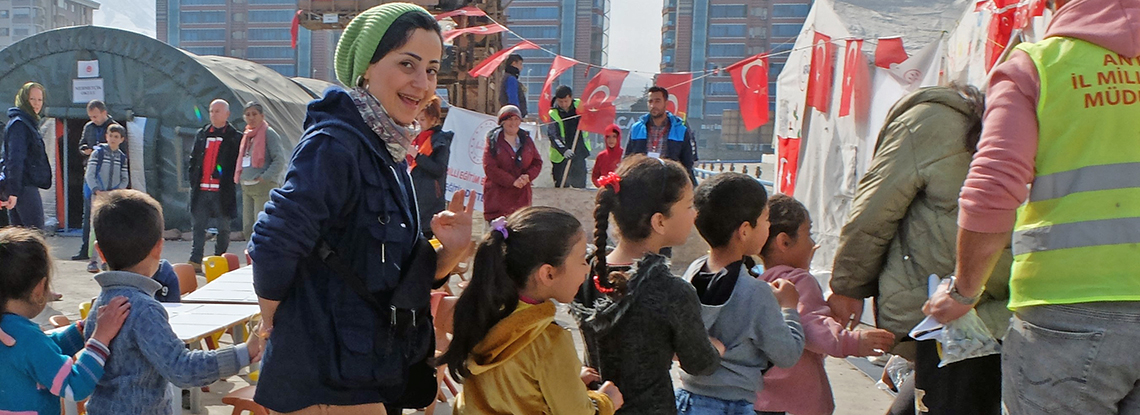
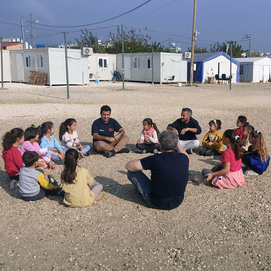
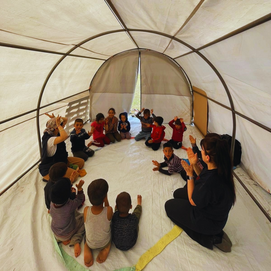
In addition to Lina Bäuerle, the team consisted of 6 Turkish and one German Emergency Pedagogue. The pedagogical work mainly took place in camps and schools, as in the previous interventions. During the day, the team worked with over 100 children between the ages of 3 and 13. In addition, the team offered an introductory training for local educators in the evenings. Up to 40 local pedagogues took part in the events, which included practical as well as theoretical components. Due to the diverse composition of the team, the children and pedagogues were offered a variety of emergency pedagogical methods. The practical sessions consisted of trauma sensitive experiential educational, such as movement and music, and artistic activities such as water colouring, working with clay and free painting.
The team of eight was on site for a week. With the support of our local coordinator Cansu Kaygisiz, two child Friendly Spaces opened in Hatay in November, where up to 60 children will receive Emergency Pedagogical support until summer 2024.
In the Wake of the Earthquake in Turkey: Parents Concerned About Their Children's Future
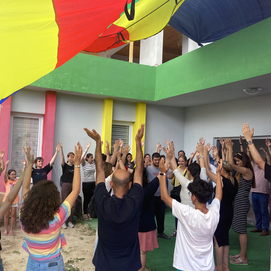
From the 24th of June to the 8th of July 2023, an international team from Friends of Waldorf Education, consisting of seven Turkish, three German, and two Iraqi Emergency Pedagogues, worked with children, parents, and educators in the Hatay province. "The destruction in the region is still very evident," reports team leader Fiona Bay, "some areas have been cleaned up, but debris and rubble still dominates the overall picture." Many people are still living in tents in front of or next to their destroyed homes, as well as in large tent and container camps, even months after the earthquake. During our intervention in Hatay, we worked with children and parents at the same time. After an initial circle with parents and children, our team split up so the parents could feel free to discuss everything in the absence of their children.
"In our parental work in the Hatay province, mainly mothers and even a few fathers participated," reports Turkish Emergency Pedagogue Filiz Karahasanoğlu, "many men work abroad and come home once or twice a year for a month." Thus, mothers bear almost sole responsibility for the family. The advantage is that those jobs abroad were preserved, while many people in Hatay lost their jobs due to the earthquake. However, for the women living alone with their children in the tent camps, it is difficult: "Many women do not feel safe and especially at night, they only dare to use the communal toilets if they are accompanied," Karahasanoğlu reports.
The work with parents included psychoeducation on trauma, grief processes, as well as parenting counseling, particularly regarding dealing with fears and nightmares. Additionally, we conducted stabilization, body awareness, movement, breathing, and concentration exercises, as well as offering artistic crafting and handcraft activities.
"The parents were very open, had a lot to say, and a strong need to communicate," says Karahasanoğlu. "They told us how they experienced the earthquake, how they reacted, and how they kept their children safe. They also talked about the mistakes they made in the process. One participant blamed herself severely because she had placed a cupboard near the entrance door, which fell over during the earthquake and blocked the exit." The biggest concern for the parents was their children's fears. Some refuse to sleep alone. Many don't want to leave or enter specific places like the house or the tent. Some have become very quiet after the earthquake, they don't want to talk anymore, and withdraw. Some have become unusually aggressive. Since many relatives died in the earthquake, there was also a lot of anxiety that the surviving parents also might die. For example, a 6-year-old child asked its mother, "Mom, what should I do if you die as well?" We worked with the parents on how to handle the children's fears and concerns.
Not only the children but also the parents have experienced severe trauma. They have lost family members and other loved ones and haven't been able to truly grieve yet due to other problems and issues taking precedence. They fear the future and are apprehensive about facing another winter in emergency shelters.
We worked with them to strengthen and expand their resources. What am I good at? How can I reactivate my skills? What possibilities do I have? How can I shape my life? What can Ido to make it happen?
Self-efficacy, or the ability to take action was particularly evident in the handcraft work. After we had crafted dreamcatchers from wool, the participants wanted to continue with handcrafting. "One woman remembered that she still had pearls and brought them along," Filiz Karahasanoğlu recalls. "As a result, the whole group made bracelets. This led to more ideas, and everyone looked for materials they had and brought them. One participant could crochet bags and taught the others. They were happy to create something together. They became so productive that they even considered making and selling something."
Due to the high need for psychological support, we established contact with the Turkish Psychologists Association in Hatay to provide and ensure long-term psychological counseling. Families are now offered weekly counseling or therapy on an ongoing basis.
A group of Turkish Emergency Pedagogues will carry out an intervention in Hatay at the end of August. Additionally, another international team is planned to return there in October to offer further support.
Emergency Pedagogy in the Turkish earth quake zone
On 4th of March, an Emergency Pedagogical team of the Friends of Waldorf Education and started its work in Turkey with a one-day seminar in Istanbul. The participants, with and without pedagogical experience, were grateful for the knowledge they gained about trauma, its symptoms and methods that can be used in their work with traumatized people. The intervention, financially supported by donations from Germany`s Relief Coalition (Aktion Deutschland Hilft), began on March 6th and 7th in Malatya with a total team of 14, including members from Germany, Switzerland, Greece and Iraq, as well as seven pedagogues from Turkey. In the eastern Anatolian city of Malatya, it is noticeable that there is no large-scale destruction. Yet between individual houses that look almost intact, other houses have completely collapsed.
"We have been working with Turkish children who were evacuated because their houses were destroyed or no longer safe enough," reported Head of Mission Raphaela Logemann while she was there, "as well as Syrian children who were either already living in Turkey as refugees at the time of the quake or came after the earthquake and have been here for about three weeks. There are also some children from Afghanistan."
In addition to the work with the children, the intervention is being used to build networks. "We are networking with other NGOs - regionally and internationally - to evaluate how to build long-term Emergency Pedagogical structures," Logemann said.
On March 8th, the team travelled on to Gaziantep, an area closer to the quake's epicentre. Here the destruction is more extensive. Houses that have not completely collapsed are usually so badly damaged that they are no longer habitable. Work began in nearby Pazarcık in Kahramanmaraş province with Turkish children in a camp. The Emergency Pedagogical work with the children was characterized by an opening and closing circle. In between, age-appropriate activities took place, such as storytelling, painting, working with clay, circle games and movement.